|
| 商品編號: | DCB0588 | |
| 商品名稱: | Eastern Encounters:Canadian Women’s Writing about the East, 1867-1929 出版公司:國立臺灣大學出版中心 作者:Shoshannah Ganz 類型:世界文學-世界文學總論 EPUB電子書 繁體中文版 | | | 語系版本: | EPUB電子書 繁體中文版 | |
| 運行平台: | EPUB電子書,沒有任何平台限制,終身使用 | |
| 更新日期: | 2025-09-01 | |
| 光碟片數: | 1片CD光碟 | |
| 銷售價格: | $100元 | |
| 熱門標籤: | Ganz
Shoshannah
East
Writing
Womens
Canadian
Encounters
Eastern
| |
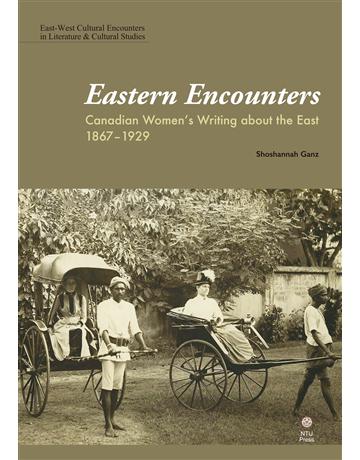
Eastern Encounters:Canadian Women’s Writing about the East, 1867-1929 出版公司:國立臺灣大學出版中心 作者:Shoshannah Ganz 類型:世界文學-世界文學總論 EPUB電子書 繁體中文版
商品資料
作者:Shoshannah Ganz
出版社:國立臺灣大學出版中心
出版日期:2017-05-04
課程類型:世界文學>世界文學總論
ISBN/ISSN:9789863502302
內容簡介
Eastern Encounters releases early Canadian women writers from a simple focus on autobiography and racial politics and interrogates their specific and sophisticated Asian influences. With a compelling reconstruction of historical context, Ganz has created perhaps the first book in a much-needed series that will revisit Canadian nationalism through the important cultural exchanges she examines. Though shaped with an Asian readership in mind, Eastern Encounters is an important work for all who wish to challenge the notion that Judeo-Christian traditions almost exclusively shaped early Canadian discourse.
作者簡介: Shoshannah Ganz is Associate Professor of English at Grenfell Campus, Memorial University of Newfoundland in Canada. Her areas of interest include Canadian literature; Canadian literature and ecology; and the influence of Japanese literature and culture on Canadian writers and writing. Shoshannah has published on a number of Canadian authors and co-edited The Ivory Thought: Essays on Al Purdy with the University of Ottawa Press in 2008. Her current research looks at the way industry is figured in the literature of Canada and Japan and the impacts of industry on humans and the more-than-human environment. This research extends beyond the literary texts to explore the remaking and remarketing of the post-industrial landscapes of Japan and Canada as tourist destinations.
作者序
Introduction (Excerpt)
Canadian Nationalism
The question of what constitutes Canadian identity and the closely related question of what represents a Canadian literary tradition and history have been at the core of the activities of Canadian literary critics and writers since the nascence of the Canadian nation with, and even before, confederation in 1867. In the early pre- and post-confederation years, a number of poets and writers were searching for Canadian topics and a poetry that could be celebrated as uniquely Canadian. Satirizing this struggle in the April 27, 1929 issue of the McGill Fortnightly Review, Montreal poet and critic F. R. Scott (1899–1985) published his much-quoted poetic critique of the Canadian Authors’ Association, an organization founded in 1921 “to promote the interests of Canadian writers” (Bentley 3). “The Canadian Authors Meet” refers back to the poets collectively known as the Confederation poets, “[Bliss] Carman, [Archibald] Lampman, [Sir Charles G. D.] Roberts, [William Wilfred] Campbell, [Duncan Campbell] Scott” (line 10). The poem concludes by summing up the state of establishment Canadian poetry as follows: “O Canada, O Canada, Oh can / A day go by without new authors springing / To paint the native maple, and to plan / More ways to set the selfsame welkin ringing?” (lines 21–24). Against this background of nationalist fervour encapsulated by declarations of “O Canada” and the “native maple,” F. R. Scott and other modernist poets were attempting to develop and define a more rigorous, experimental, and particularly international poetry—a poetry A. J. M. Smith (1902–1980) would call “cosmopolitan” in the Preface to the 1943 anthology The Book of Canadian Poetry (1943; rev. 1948, 1957). The modernist poetic and political opposition to the rhetoric of the local and national obsessions that had kept the “selfsame welkin ringing” for the first fifty years of Canadian literary history marked a shift in Canadian literature and culture.
While the above is a standard introduction to Canadian nationalist topics and values and the cosmopolitan perspective, as introduced by male critics/poets such as A. J. M. Smith and F. R. Scott, there also exists a parallel and somewhat different poetic history that chronicles not the “maple leaf forever,” but subtle expressions of Eastern influence and sensibility. The all-but-forgotten Canadian modernist poet Louise Morey Bowman (1882–1944), hailed in her day by American modernist poets, questions colonial presence in India in poems such as “Garden in Agra,” which she begins by asking, “Cool-blossomed English garden! What wide fate / Set you in burning breathless India?” (lines 1–2). The poem was originally published in Canadian Author’s Association Poetry Year Book 1926–1927 and republished by Wanda Campbell as part of her early Canadian women’s poetry recovery project in Hidden Rooms (2000). Bowman likewise works in the Japanese form of Hokku, showing—like many of the American modernist poets, and well ahead of her male Canadian modernist counterparts—the influence of Japanese poetics on the sparseness and form of modernist poetry. Part of Dream Tapestries (1924), “Twelve Hokku on a Canadian Theme” and “Life Sequence (In the Hokku Manner)” are republished in Campbell’s Hidden Rooms as early examples of the Japanese influence on Canadian women’s poetry. Bowman, among others, illustrates how women’s voices and the influence of the East on Canadian modernism and the Canadian literary tradition have been, as Campbell’s title clearly shows, hidden and excluded from Canadian history and the Canadian literary canon. This book is dedicated to the study of Canadian prose fiction and non-fiction. However, like Wanda Campbell’s anthology of early Canadian women’s poetry, this project is an attempt to recover women’s voices, and particularly those Canadian women influenced by Japan, India, and China.
The study of Canadian literature as a field and the efforts to define Canadian nationalism emerged together in the 1960s, with contributions by a number of leading writers and critics, including most famously George Grant, Northrop Frye, Margaret Atwood, and Robert Kroetsch. While I will be outlining their theories of Canadian nationalism—particularly for a readership in Asia, who may not be familiar with their ideas—I will intersperse and conclude this survey by questioning the ways in which the ideas about nationhood promoted by these writers and thinkers are complicated or reinforced by the history and literature relating to Asian Canadian identity.
In 1965, nearly a hundred years after confederation, George Grant would ask “can the disappearance of an unimportant nation be worthy of serious grief?” (3). In his “Lament for a Nation: The Defeat of Canadian Nationalism” Grant names many of the historical characteristics to which Canada looked in defining its collective identity. These qualities include, most succinctly “[t]he inherited determinism not to be Americans” (6) and allegiance to the British Crown as expressing “a continuing loyalty to the state” (6). Canada, writes Grant, was based on the “inchoate desire to build . . . a society with a greater sense of order and restraint than freedom-loving republicanism would allow” (6). Grant argues that “Canada’s disappearance was a matter of necessity” (4) and further that “[t]he aspirations of progress have made Canada redundant” (4). However, in the years of early nationhood (defined in this study as 1867–1929), Canada, in Grant’s estimation, was still attempting to preserve aspects of the British Crown in order to “distinguish [Canada] from the United States” (7). This summation undoubtedly explains aspects of early Canadian identity and culture. But in the case of writers such as Sara Jeannette Duncan, while connections to Britain existed in a limited sense, Canadian identity was expressed chiefly in setting itself apart from both the British and the American influences. This can be widely observed in early Canadian literature. However, Grant is not writing about or referring to the literature of early Canada; rather, his thesis is that “[t]he purpose of life is consumption” (7). When looking at early and contemporary Canada from an economic perspective, Grant’s estimations hold some truth. Canada’s economic ties with Britain in the nineteenth century were a necessary reality, just as, in the twentieth and twenty-first centuries, trade with the United States and participation in global corporations is part of the Canadian and global economy. However, while the early Canadian women writers do express some relationship to Britain, chiefly through trade, the literature expresses a stronger determination to define Canadian identity as different from both British and American identity.
Northrop Frye, writing in the same year as George Grant, in his “Conclusion to A Literary History of Canada” (ed. Carl F. Klinck 1965) in referring to the literary history of Canada, settles on a single metanarrative for Canada as a nation. Of further importance to this study, Frye connects Canadian identity formation to the East. He writes, “Canada began as an obstacle, blocking the way to the treasures of the East, to be explored only in the hope of finding a passage through it. English Canada continued to be that long after what is now the United States had become a defined part of the Western world” (10). While Frye goes on to echo Grant’s determination of Canada as defined partly in opposition to the United States and partly through its alignment with the values and history of Britain, Frye does not see Canada as being lost to global trade or the American market economy. Rather, Frye develops the difference between Canada and the United States by suggesting that “[t]o enter the United States is a matter of crossing an ocean; to enter Canada is a matter of being silently swallowed by an alien continent” (11). Surely this difference signifies a terrifying unknowability to Canadian identity, although he later concludes this conversation by suggesting that “[t]he Canadian genius for compromise is reflected in the existence of Canada itself” (12). Ultimately, however, Frye argues the defining quality of Canada “is the position of the frontier in the Canadian imagination” (12). Frye explains that “[t]he frontier was primarily what separated the Canadian, physically or mentally, from Great Britain, from the United States, and even more important, from other Canadian communities” (13). In Frye’s summation, Canadians and Canadian literature were and would continue to be characterized by “what we may provisionally call a garrison mentality” (14). According to Frye “[t]he real terror comes when the individual feels himself becoming an individual, pulling away from the group, losing the sense of driving power that the group gives him, aware of a conflict within himself far subtler than the struggle of morality against evil” (15). It is in this context Frye postulates that it becomes easier to build more garrisons; the result is that this blocks the creative development of the nation and stymies the artist with “a dominating herd-mind in which nothing original can grow” (15).
Margaret Atwood’s own writing would belie this easy summation, and her own theory of Canadian literature would respond to Frye’s dismal proclamation about the climate of Canadian creativity. Writing in 1972, Atwood notes in Survival: A Thematic Guide to Canadian Literature that “[u]ntil recently, reading Canadian literature has been for me and for everyone else who did it a personal interest, since it was not taught, required or even mentioned (except with derision) in the public sphere” (20). Certainly Frye’s contentions about the creative climate of Canada paints a picture of an environment hostile to innovation and individual talent—an environment that brings attention, like Atwood suggests, to the national literature through derision.
Atwood sets out to respond to this proclamation and, in the process, answer two questions in her work: “What’s Canadian about Canadian literature, and why should we be bothered” (20–21)? Without a doubt both these questions are pertinent to this study, although Atwood’s answer forms only a portion of the literary/critical history of Canadian literature and, perhaps, something of a response to Frye. Atwood contends that the study of Canadian literature “ought to be comparative” (23), going on to suggest that “it is by contrast that distinctive patterns show up most strongly” (23) and that “[t]o know ourselves, we must know our own literature; to know ourselves accurately, we need to know it as a part of literature as a whole” (23).
The necessity of the comparative component of knowing the self and the literature of the nation in relation to other nationalities and literatures applies to the study I am here undertaking. However, Atwood does not include Asian literature or culture in her study and refers primarily to comparing the literature of Canada to that of the Anglo-American tradition. Atwood goes on to respond specifically to Frye’s suggestion that knowing the self is at least in part “the same as the answer to another question: ‘Where is here’” (23)? The claim for the distinctiveness of Canadian literature and the Canadian experience are in part to be found in the answers to these questions. According to Atwood and echoing Frye, “Canada is an unknown territory for the people who live in it” (24) and “[w]hat a lost person needs is a map of the territory” (24). What Atwood provides is a guide and a “central symbol for Canada” (25) in the trope of survival. Atwood charts this central symbol of survival in the literature of English and French Canada from the early literature that deals with physical survival to the literature of the 1970s that deals with what Atwood characterizes as “spiritual survival” (26).
Robert Kroetsch, in “Disunity as Unity: A Canadian Strategy” (1989), observes, “The shared story . . . has traditionally been basic to nationhood” (61), yet he contends that “Canadians cannot agree on what their meta-narrative is” and that “this very falling-apart of our story is what holds our story together” (61). Referring to Yeats’ observation that “the centre does not hold” (62) Kroetsch argues that “[i]t was this very decentering that gave a new energy to countries like Canada” (62). Further, “Canada is supremely a country of margins, beginning from the literal way in which almost every city borders on a wilderness” (62). Returning to the earlier discussions of Grant and Frye, Kroetsch also suggests that “[w]e define ourselves, often, as the cliche has it, by explaining to Americans that we aren’t British, to the British that we aren’t Americans” (66); similarly, he echoes Atwood’s trope of survival when he notes, “[W]e survive by working with a low level of self-definition and national definition” (66). By highlighting what he sees as a lack of a single metanarrative to sum up the diversity of Canadians and the multiplicity of definitions of Canadians, Kroetsch identifies a key to understanding Canadian culture. He notes that “[w]e maintain ethnic customs long after they’ve disappeared in the country of origin” (66) and “[i]n Canadian writing there is little sense of a privileged self at the centre” (66). According to Kroetsch, the “archetypal Canadian” is characterized “by refusing to become a Canadian” (67).
I draw attention to these Canadian writers and critics because they highlight a number of the qualities that make Canada and Canadians distinctive; some or all of these characteristics contribute to the interactions and formations of relationships with and between Canadian writers and their travel to and writing about China, Japan, and India and, more broadly, to the subject of this study. Certainly many Canadian writers, particularly in their travels in China, Japan, and India, define themselves and their reactions to places and people—and thus promote their ideas about different cultures—with and against British and American norms, identities, and writing. Many Canadian writers also take the opportunity in their writing to promote various forms of Canadian nationalism.
The question that emerges is how these definitions of nationhood and nationalism that emerge in the writing about the East or reflecting the Eastern influence reinforce or support the theories of nationhood put forth by Grant, Frye, Atwood, and Kroetsch and if and how these theories work alongside the histories and stories of Asian Canadians? Certainly Atwood’s concept of survival could apply to the struggles for and emergence of an Asian Canadian presence in the literature; however, this is not in fact articulated as part of her study. Even Frye’s notion of a “garrison mentality,” constructed by Canadians to protect them from the Indigenous inhabitants and the wilderness, could arguably be seen as re-enacted in the position Canada eventually took toward immigrants from Asia and Asian Canadians. Extending this idea further, Canadians arguably used a form of garrison to incarcerate Japanese Canadians when they saw them as a threat; even before this, the federal government enacted laws to keep out Chinese, Japanese, and South Asian immigrants, thus forming a sort of national garrison around a predominantly white national identity. Certainly Kroetsch’s theory allows for a multiplicity of narratives of nationhood: it undermines the overdetermined and totalizing meta-narratives of nationhood that require an essentially white-settler history and, thus, allows for the margins and marginalized identities to become part of the fabric of nationhood.
Smaro Kamboureli, however, in the introduction to the first edition of Making a Difference: Canadian Multicultural Literature in English (2007), questions this idea of marginalization: “if we consider these authors in the various contexts that have produced their writing, it becomes apparent that ‘marginalization’, from an individual as well as a collective perspective, is impossible to define in any stable way” (xix). Thus, a clear articulation of the stories of nationhood that includes Asian presence from and before confederation requires not only a re-examination of the history and stories that are excluded in the nationalisms articulated by the founding and establishment Canadian scholars but also a rewriting of the story of nation to include Asian stories and origins as part of the emergence of Canada as a nation. Rather than relegating Asian Canadian presence to the “impossible to define” (Kamboureli xix) margins, this study intends to put the Asian influence on Canadian nation-building at the centre. Scholars such as Arun Mukherjee contend that “Canadian nationalism, for us non-whites, is a racist ideology that has branded us un-Canadian by acts of omission and commission” (“Canadian Nationalism” 89). A number of recent writers and scholars attempt to address the “acts of omission and commission” in the white-settler-culture, nation-building narrative, including Roy Miki and Smaro Kamboureli, and what follows will examine their perspectives.
This study intends to take the story of Canada back to the beginnings of Asian immigration and weave together the history of Canada with the emergence of the history and identities of Asian Canadians as part of the story of the historical creation of a Canadian national identity. Further, this study will emphasize that the influence of Asia on the formation of Canadian identity, culture, and literature has been a part of the story from the very beginnings of the nation—not just from within, but also from without. In this case I am referring to the Canadians who travelled to Asia and brought back stories, artifacts, religious experiences, and culture to their communities in Canada, as well as to the influence on Canadians from Asians living in Canada and becoming Canadians. I am also referring to the circulation of ideas about Asia that came from literature, art, and artifacts that were brought into the nation and into individual homes, museums, and public places through missionary activities, trade, and travel, and the impact of Asian culture on Canada through the impact of art and ideas from Asia. As the editors of ReCalling Early Canada: Reading the Political in Literary and Cultural Production (2005) note, “[E]arly Canadian artifacts offer particularly revealing sites in which it is possible to trace the gains and losses of the imposition of the nation—with its demands of cohesion and homogeneity—upon the many and various preoccupations of artists, writers, and cultural commentators” (Blair, Coleman, Higginson, York xxvii). An examination of the “early Canadian artifacts” thus shows the traces of the Asian influence and can contribute to “counteract[ing] the racist nationalist discourse of two founding nations” (Mukherjee, “Canadian Nationalism” 82) that would erase the presence of Asian Canadians from the otherwise homogenizing original nation-building story. This offers the possibility of both recuperating and reconfiguring the nation-building narrative to show a story of exchange and influence from Asia rather than merely erasing the differences or showing the racism of the early stories of nationhood.
目錄
Dedication
Introduction
1 Sara Jeannette Duncan, Mrs. Howard Vincent and Ellen Agnes Bilbrough: Canadian Travel Writing About Japan, China, and India
2 A Fictional Remembering of India? Anna Leonowens’s Travel Writing
3 The Eastern Threat to Women’s Enfranchisement in Nellie McClung’s Purple Springs
4 Literary Fake or Translating Genius? Onoto Watanna’s Translations of Japanese Literary Motifs from The Tale of Genji in Tama (1910) and The Honourable Miss Moonlight (1912)
5 The Teachings of the Compassionate Beck: Buddhist Philosophy, ilgrimage, and The House of Fulfilment
Postscript
Acknowledgements
Previously Published
Works Consulted
Index
|


 您現在的位置:
 電子書綜合教學

