|
| 商品編號: | DCF1505 | |
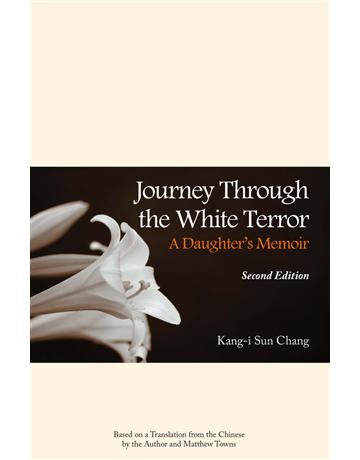
| 商品名稱: | Journey Through the White Terror: A Daughter’s Memoir 出版公司:國立臺灣大學出版中心 作者:Kang-i Sun Chang 類型:歷史地理-台灣研究 PDF電子書 英文版 | | | 語系版本: | 英文版 | |
| 運行平台: | PDF電子書,沒有任何平台限制,終身使用 | |
| 更新日期: | 2025-09-01 | |
| 光碟片數: | 1片CD光碟 | |
| 銷售價格: | $100元 | |
| 熱門標籤: | 歷史地理
台灣研究
Journey
Through
White
Terror
Daughters
Memoir
| |
Journey Through the White Terror: A Daughter’s Memoir 出版公司:國立臺灣大學出版中心 作者:Kang-i Sun Chang 類型:歷史地理-台灣研究 PDF電子書 英文版
商品資料
作者:Kang-i Sun Chang 、譯者:Matthew Towns
出版社:國立臺灣大學出版中心
出版日期:2013-02-06
課程類型:歷史地理>台灣研究
ISBN/ISSN:9789860359725
內容簡介
Kang-i Sun Chang is Malcolm G. Chace ’56 Professor of East Asian Languages and Literatures at Yale University. In her memoir, Journey Through the White Terror, she tells the powerful story of her father Paul Sun (1919-2007). Along with numerous others, Sun was imprisoned more than 60 years ago during the “White Terror”, the decade following the withdrawal of Chiang Kai-shek’s Nationalist government from Mainland China to Taiwan in mid-December 1949. During this time, the Nationalist government implemented a policy of “better to kill ten thousand by mistake than to set one free by oversight,” and as a result, many innocent civilians such as the author’s father became victims of ferocious searches and persecutions. At the time of her father’s arrest, Prof. Chang was not quite six years old; when her father returned home, she was almost sixteen. Having witnessed the injustice of her father’s imprisonment and the freedom their family later enjoyed in America, she felt compelled to write this story.
Prof. Chang’s account of how the family survived the White Terror makes her book one of the most intense and thrilling works on the subject. But the book is also about soul-searching and the healing of a childhood trauma. It is a true story about the triumph of the human spirit in the face of adversity. Love and religion in such circumstances prove to be the ultimate deliverance. All this is described in considerable detail in this extraordinary memoir.作者簡介: The Author
Kang-i Sun Chang
Kang-i Sun Chang was born in 1944 in Beijing, China, and grew up in Taiwan. She immigrated to the United States in 1968. She is now Malcolm G. Chace ’56 Professor of East Asian Languages and Literatures at Yale University.
The Co-translator
Matthew Towns
Matthew Towns received his B.A. and M.A. degrees from Yale University in 2000. He is currently practicing law in Missouri.
各界推薦
名人推薦: “A prize winning scholar and teacher, Kang-i Chang shows another rare gift in this powerful memoir. Journey Through the White Terror is an unforgettable account of a child and family caught in the storm tides of history. Though the subject is deeply emotional, Professor Chang’s clarity and honesty prevail throughout.”
—Richard H. Brodhead, President, Duke University
“Compared to the experiences of many White Terror victims, the story of Kang-i Sun Chang’s parents has a happy ending. And what moves us most is not only the deep love that her father and mother shared, allowing them to remain mutually faithful for so long, but also the self-respect and determination to overcome hardship that was born in the midst of their great individual solitude.”
—David Der-wei Wang, the Edward C. Henderson Professor of Chinese Literature, Harvard University
“In this highly original and emotionally evocative work, Kang-i Chang recounts the memoir of her childhood during the White Terror with profound psychological insight into the critical value of family and faith as she and her parents navigate the shifting tides of politics and fortune. And in an unforgettable way, she again reminds us of the great pain carried always by all such survivors, reflecting, in the words of William Faulkner: ‘The past is never dead. It's not even past.’ ”
—John F. Setaro, M.D., Associate Professor of Medicine, Yale University School of Medicine
“The content [of this book] is striking in its immediacy, heart-warming in its humanity, and as a historical document it is extraordinarily informative about otherwise shadowy events. It is truly a deeply moving story, or collection of stories, that will long stay in my memory.”
—F.W. Mote, the late Professor Emeritus of Chinese History, Princeton University
“An incomprehensible accusation, unaccountable acts of benevolence, a sensitive account of difficult times and the story of the growth of a scholar’s mind: such is the content of Journey Through the White Terror, tied up with ironies of fate and happy endings. Kang-i Sun Chang’s family history intertwines with the creation and dissolution of political blocs, shifts in Chinese and Taiwanese identity, and the opening-up of the United States to Asian immigration. It makes Cold War Asia understandable through the gestures of daily life, of sewing, rumors, sweet potatoes, and long-awaited letters.”
—Haun Saussy, University Professor of Comparative Literature, University of Chicago
作者序
Journey Through the White Terror tells the story of my father Paul Sun, who, like many others, was imprisoned more than 60 years ago during the “White Terror,” the decade following the withdrawal of Chiang Kai-shek’s Nationalist government from Mainland China to Taiwan in mid-December 1949. During this time, the Nationalist government implemented a policy of “better to kill ten thousand by mistake than to set one free by oversight,” and as a result, many innocent civilians such as my father became victims of ferocious searches and persecutions. At the time of my father’s arrest, I was not quite six years old; when he returned home, I was almost sixteen. Having witnessed the injustice of my father’s imprisonment and the freedom my family later enjoyed in America, I felt compelled to write this story. I have included in the book reflections on my father’s imprisonment and absence during my childhood, as well as accounts of the experience of my other family members and friends. The book concludes with thoughts on my life in the U.S.
But my book is not accusation literature. Neither is it literature of the wounded. On the contrary, this is a book about soul-searching and the healing of a childhood trauma. As I stand at today’s high point and recall the past, I find that I have learned a great deal; I had always thought that the hardships encountered in my youth were a deficiency in my life, but now I discover that they were a spiritual asset. I am grateful for those difficult early life experiences, for they allowed me to acquire maturity quickly while growing up, and allowed me to find a complete self amid shortcomings.
Thus, this book is also about bidding farewell to the White Terror. Although the chapters and passages written in my memoir often relate to the inhumanity of the White Terror, the foundation of the book rests on sketches of real-life heroes in the modern world. Those heroes are often nothing other than modest mentors whose talent and generosity helped us survive the difficult times. It is about aunts and uncles and friends whose contributions to the lives of our family will always be treasured by us.
Here, you will find the story of a pedicab driver who made it possible for a political prisoner to be briefly reunited with his family. You will read how that same driver’s act of generosity—which took place in Taiwan—was returned as a favor to the benefit of another pedicab driver after the lengthy span of fifty years on the mainland, in Beijing. And you will find the story of an unassuming elementary schoolteacher in Taiwan who gave me my earliest lessons in Chinese philosophy, which would later become one of the subjects that I teach in the U.S. Among the book’s most significant stories are those of important literary figures who were family friends. One of them, Chang Wo-chun, assisted our family during a risky journey out of the mainland in 1946. Then there is the story of my uncle Chen Pen-chiang and the novelist Lu Heruo, whose firm adherence to the ideals of socialism led to one of the most significant political uprisings of the post-1949 era in Taiwan. Finally, but far from least among them, there is the story of my parents, who had learned to hear the voice of God. B9Their faith helped sustain them through the difficult journey of the White Terror.
The White Terror in Taiwan generally refers to the period of martial law that began in 1949. But in fact, as early as 1946, people in Taiwan could already sense that catastrophic times could erupt at any moment. Our family must have been among the first Mainlanders to go to Taiwan, as we left China in the spring of 1946. China was still ruled by Chiang Kaishek’s Kuomintang (KMT). A year before that, World War II had just ended, marking a special year of victory for the Chinese, as Japan, the common enemy of all of China, was finally defeated. With Japan’s surrender, Taiwan
was restored to Chinese rule after fifty years of Japanese occupation, and thousands of Japanese were forced to leave Taiwan. At the time, Taiwan’s citizens were hoping that under the new rule of the Chinese Nationalists, things would improve on the Taiwan island. Meanwhile, Taiwan suddenly became a new land of opportunity, and many Mainlanders went to Taiwan to assume new positions. The primary reason my parents decided to go to Taiwan was to look for good job opportunities. Because my mother originally came from Taiwan, the trip to Taiwan became even more desirable.
Unfortunately, the year after our arrival in Taiwan, the February 28th Incident, also known as the 228 Massacre, suddenly erupted. In fact the February 28th Incident in 1947 already marked the beginning of the White Terror Period. According to reliable estimates, thousands of Taiwanese and Mainlanders were either imprisoned or executed during those years. My father was imprisoned from 1950 to 1960. During those ten years, my mother became a sewing teacher to support her three children. Without my mother, my family would not have survived the White Terror years. Even when my father was released from the prison in 1960, no one dared to hire him until finally a courageous high school principal appointed him as an English teacher.
Indeed, our journey has been difficult. It’s true that more than sixty years ago, almost all Mainlanders who went from China to Taiwan experienced the tragedy of being cut off from their families on separate lands. But unlike most other people, our family’s tragedy was twofold. At the same time our mainland relatives were being branded Rightists and put through unending torture in China, my father, a mainland Chinese, was falsely labeled a leftist criminal in Taiwan. All the while, of course, our relatives on the mainland were completely unaware of everything we underwent in Taiwan. This is indeed a great irony in modern history. An irony such as this is a tragedy of the times; it is entirely the creation of an unfortunate political situation.
In the meantime, martial law was lifted in 1987, and Taiwan has since become a democratic society. It is possible for me now to view the White Terror episode in a new perspective. After all, the Ma-chang-ting area in Taipei, which used to b+B11e the place for executing political dissidents during the White Terror era, has now become the Memorial Park in remembrance of the victims during the 1950s.
Indeed, the story of Taiwan is one of great change. When hearing about my White Terror memoir, my Yale colleague Beatrice Bartlett, who had been teaching a Taiwan history course for forty years, commented: “It is certainly a remarkable change—isn’t it—that such books can now be written and published on Taiwan. When I lived there, saying the words ‘erh-erh-pa’ [2-28 Incident] out loud in public would get you stared at—or worse!”
Needless to say, in writing this book I have accumulated many debts of gratitude over the years, far beyond those I have already mentioned above. First of all, my thanks go to my father Paul Sun (1919-2007) and my mother Yu-chen Chen Sun (1922-1997) for the love and encouragement they gave me throughout the difficult years. I am also deeply grateful to my husband C.C. Chang. His many years of enthusiasm and imagination helped me bid farewell to the shadows of the past. I would also like to thank my brothers K.C. and Michael for sharing their experience with me. In addition, I have learned from talking to many people: David Der-wei Wang, Ke Ching-ming, Yu-kung Kao, Chin-shing Huang, Ayling Wang, Sher-shiueh Li, Chi-hsiang Lee, Liao Chih-feng, Fan Ming-ju, Chen-main Wang, Jianmei Liu, Jeongsoo Shin, Michael Holquist, Elise Snyder, Richard H. Brodhead, Stanley Weinstein, Edwin McClellan, Harold Bloom, John Treat, Jing Tsu, John F. Setaro, Haun Saussy, Olga Lomova, Cecile Cohen, Reva Alavian Pollack, and others. I am grateful to all of them for their friendship and inspiring conversations over the years.
In particular, I wish to express my appreciation to the late professor of Chinese history Frederick W. Mote, who read the original Chinese edition of this book with the utmost care and urged me to publish the work again in “its English language rebirth,” for he said “it deserves to reach a wider audience” in this way. It was largely due to his inspiration that I was able to add new historical background information to the English edition. I am also grateful to Leslie Wharton, my long-time friend from the Princeton years during the 1970s, who urged me to publish a revised and enlarged edition for the new global readership.
I am indebted to Matthew Towns for his invaluable help during the process of translation. I also want to give thanks to Jessica Moyer for helping me translate one of my Chinese essays (“My Father’s Hands”), and to my research assistant Victoria Wu who made crucial contributions to the entire process of revision, including translating David Wang’s foreword for this new edition.
The Council on East Asian Studies at Yale University generously supported my research on this project, and subsequently provided subsidy grants to help the publication of this book. I am grateful to Daniel Botsman, Chair of the Council, and Abbey Newman, Melissa Jungeblut,and Amy Greenberg for their continuous support.
For their unfailing support, I also owe a debt of gratitude to Hsiang Jieh, Director of the National Taiwan University Press, and to the editors Tina Pan and Harry Tsai.
K.S.C.
Yale University
January 2013
目錄
From “Swallowing Hatred” to Gratitude: Witnessing the White Terror
David Der-wei Wang
Preface
CHAPTER 1: The February 28th Incident
CHAPTER 2: Age Six
CHAPTER 3: Father’s Story
CHAPTER 4: On the Road to Visit My Father in Prison
CHAPTER 5: My Teacher Mr. Lan
CHAPTER 6: Mother’s Steadfastness
CHAPTER 7: Out from Prison
CHAPTER 8: A Tale of Two Families
CHAPTER 9: Reborn from the Ashes
CHAPTER 10: In the Language Gap
CHAPTER 11: My Uncle Chen Pen-chiang and the Taiwanese Writer Lu Heruo
CHAPTER 12: The Escape from the Tiger’s Mouth
CHAPTER 13: Red Bean Inspiration
CHAPTER 14: Victims on Both Shores
CHAPTER 15: Journey Through the Classics
CHAPTER 16: Moses as I Know Him
CHAPTER 17: The Pragmatic Pioneer
CHAPTER 18: Second Aunt’s Legacy
CHAPTER 19: The Last Card
CHAPTER 20: A Trip to Angel Island
CHAPTER 21: Return to Green Island
CHAPTER 22: My Father’s Hands
Timeline of Major Events
A Short List of Key Words, Names, and Terms
|


 您現在的位置:
 電子書綜合教學

