|
| 商品編號: | DCE6238 | |
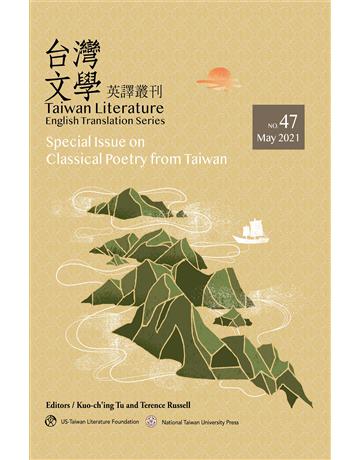
| 商品名稱: | 台灣文學英譯叢刊(No. 47):台灣古典詩歌專輯 出版公司:國立臺灣大學出版中心 作者:Kuo-ching Tu(杜國清)、Terence Russell(羅德仁)編 類型:華文文學-華文文學研究 EPUB電子書 繁體中文版 | | | 語系版本: | EPUB電子書 繁體中文版 | |
| 運行平台: | EPUB電子書,沒有任何平台限制,終身使用 | |
| 更新日期: | 2025-09-01 | |
| 光碟片數: | 1片CD光碟 | |
| 銷售價格: | $100元 | |
| 熱門標籤: | 台灣文學英譯叢刊
杜國清
羅德仁
ching
Terence
Russell
| |
台灣文學英譯叢刊(No. 47):台灣古典詩歌專輯 出版公司:國立臺灣大學出版中心 作者:Kuo-ching Tu(杜國清)、Terence Russell(羅德仁)編 類型:華文文學-華文文學研究 EPUB電子書 繁體中文版
商品資料
作者:Kuo-ching Tu(杜國清)、Terence Russell(羅德仁)編
出版社:國立臺灣大學出版中心
出版日期:2021-05-25
課程類型:華文文學>華文文學研究
ISBN/ISSN:9789863504450
內容簡介
Apart from “new poetry” composed in the vernacular language, the tradition of classical poetry originating in China has also been maintained in Taiwan. We cannot ignore the fact that those poets who continued to compose classical verse, as well as the activities of their poetry societies, are yet another aspect of the diversity of Chinese-language poetic development in Taiwan which at the same time has unique local characteristics.
Professor Huang's organization of the issue includes an introductory essay, entitled “Poems that Speak of Taiwan—Speaking of Taiwan Poetry” in which she gives a brief summary of the historical background and special character of the development of classical poetry in Taiwan.
According to her careful plan, Professor Huang divided the poems translated for this special edition into six thematic sections:
1) Taiwan and Taiwanese in the Interstices of History (6 poems)
2) Crossing the Ocean to Taiwan, Putting Down Roots that Grow Along with Chinese Culture (5 poems)
3) Poems on the Aesthetics of Natural Landscape Scenery (6 poems)
4) Climate, Natural Resources, and Food (6 poems)
5) Folk Customs, Festivals, and Sacrificial Ceremony (4 poems)
6) Poems Expressing Emotions, Sentiments and Criticisms (7 poems)
In the poetry selected for this issue we see the rich, expansive content of classical Chinese verse from Taiwan. That verse manifests the responses of Taiwanese poets to their times, to nature, to places and to people. It also reflects the many faces of Taiwan's specific temporal and geographical background through depictions of local experiences and the local spirit.
台灣詩歌的發展,除了以白話文創作的新詩之外,還有繼承中國古典詩歌傳統、延續不絕的古典詩歌創作者及其詩社活動,呈現出台灣漢詩發展的多樣性,同時又有其在地特色。
在黃美娥教授的策劃下,這一專輯的內容,除了詩選以外,本輯還有特地請黃教授撰寫一篇導論〈詩說台灣.說台灣詩〉,簡述台灣古典詩發展的歷史背景和主要特色。另一篇是黃教授撰寫的學術論文,〈實踐與轉化:日治時代臺灣傳統詩社的現代性體驗〉(摘譯)。關於詩選,共選31家,34首,根據題材,分成6個主題,以呈現台灣古典漢詩的特色。在題材上,反映社會和生活的開闊性和呼應歷史和時代的現代性。作者簡介: 【About the Editors】
Kuo-ch'ing Tu, born in Taichung, Taiwan. His research interests include Chinese literature, Chinese poetics and literary theories, comparative literature East and West, and world literatures of Chinese (Shi-Hua wenxue). He is the author of numerous books of poetry in Chinese, as well as translator of English, Japanese, and French works into Chinese.
Terence Russell is Senior Scholar in the Asian Studies Center at the University of Manitoba. He has an interest in contemporary literature in Chinese, especially the literature of Taiwan's Indigenous people. Dr. Russell has been a regular contributor to Taiwan Literature: English Translation Series, and was the guest editor of Issue 24 on Taiwan Indigenous myths and oral literature.
Mei-e Huang is Professor of the Graduate Institute of Taiwan Literature, National Taiwan University. She has long been engaged in Taiwan literary studies and historical data studies. She has written numerous papers on Taiwan literature.
【About the Translators】
Richard Rong-bin Chen is an assistant professor at the Graduate Program in Translation and Interpretation, National Taiwan University.
Terence Russell is Senior Scholar in the Asian Studies Center at the University of Manitoba.
Sophia Shi is currently a second-year Master’s student in the East Asian Languages and Cultural Studies department at University of California, Santa Barbara.
Yang Zhao is a Ph.D. candidate in the Department of East Asian Languages & Cultural Studies at the University of California, Santa Barbara.
章節試閱
Foreword to the Special Issue on Classical Poetry from Taiwan
Kuo-ch’ing Tu
For each issue of this journal, from our maiden edition in 1996 to the most recently published Issue 46, we have set a theme. We have chosen to highlight important authors and writings with particular attributes that represent the most salient features of literary development in Taiwan. However, for many years we had felt a deep sense that something was amiss because we had not been able to dedicate a special issue to poetry. That situation was finally remedied with Issue 46 (November 2020), when, with Professor Horng Shu-ling acting as guest editor, we published our Special Issue on Contemporary Poetry from Taiwan.
Yet apart from “new poetry” composed in the vernacular language, the tradition of classical poetry originating in China has also been maintained in Taiwan. We cannot ignore the fact that those poets who continued to compose classical verse, as well as the activities of their poetry societies, are yet another aspect of the diversity of Chinese-language poetic development in Taiwan which at the same time has unique local characteristics. For this reason, it goes without saying that after publishing our special issue on contemporary poetry, the next logical step was to follow up with a special issue on classical poetry. To this end we invited Professor Huang Mei-e of the Graduate Institute of Taiwan Literature at National Taiwan University to assume the responsibility of guest editor for the present volume. As anyone familiar with her outstanding achievements in this field knows, and with the esteem in which her scholarship is held, Professor Huang was the obvious choice for this task.
Apart from a selection of representative verse, Professor Huang’s organization of the issue includes an introductory essay, entitled “Poems that Speak of Taiwan—Speaking of Taiwan Poetry” in which she gives a brief summary of the historical background and special character of the development of classical poetry in Taiwan. The first part of the essay, “Poems that Speak of Taiwan” highlights the manner in which the works chosen for this special issue reflect Taiwan. The second part, “Speaking of Taiwan Poetry,” elaborates on the recurring themes and content of classical Chinese verse in Taiwan. The two parts are complementary and mutually illustrative, forming a logical structure for the issue.
In another scholarly paper written by Professor Huang, “Practice and Transformation: The Experience of Modernity in Classical Poetry Societies in Taiwan During the Period of Japanese Rule,” we find an exploration of the role of traditional Chinese poetry in Taiwan during the period of Japanese rule. We observe the process by which classical poetry formed a bridge between earlier and later poetics as it confronted the rising tide of modern Western thought and made accommodations to the Japanese colonial regime, to transform itself and become part of the context which Chinese classicalpoetry developed in Taiwan became “modern.”
In order to help us understand the special qualities found in classical poetry in Taiwan, Professor Huang has selected a total of thirty-four verses by thirty-one authors. These she has organized into six sections to demonstrate the characteristics of classical poetry in Taiwan according to their subject matter. Regarding the subject matter, the poems display an inclusive breadth broadly reflective of society and life, and the modernity responsive to history and the times. Regarding the themes, they illuminate the local experiences and the spirit of the people, times, places, and objects of Taiwan.
The historical development of classical poetry in Taiwan can be divided into three stages. The origins of classical poetry in the seventeenth century during the Zheng Chenggong period constitute the first stage. With the assistance of his counselor Chen Yonghua (1634–1680), The King Zheng Jing of Dongning, had a Confucian temple built in which he established a school to promote Confucian learning. In this way he introduced Sinitic culture and laid a foundation for the introduction of Chinese literary tradition. During the Qing dynasty, numerous Chinese literati and government officials who sojourned in Taiwan continued this tradition, eventually interacting with local Taiwanese poets through the medium of poetry societies.
The second stage was the period of Japanese rule (1895–1945). Japanese traditional culture was always deeply influenced by Chinese culture, and during the Japanese colonial period many Japanese practitioners of classical Chinese poetry ( J. kanshi 漢詩 ) came to Taiwan. They formed poetry societies through which they pursued assimilationist policies as they interacted with Taiwanese poets. In this way, Taiwan’s classical poetry played an ambiguous and complex role in cultural governance which was at once cooperative, opposed, and competitive. On the other hand, as is noted in Professor Huang’s introduction, the most important feature of classical Chinese poetry during the Japanese period was its gradual popularization and concern with everyday life. During that time, at least 370 classical poetry societies appeared in Taiwan. This speaks of a movement towards broad popularity. All poets enjoy gathering to recite their verse and compose together. Classical poetry came to be used in everyday life, including weddings and funerals. In this way the unique situation in which “society became literary, and literature became socialized” took shape. Government, culture and literature were influenced on many levels, and it is clear that the whole question of the role of classical Chinese poetry during the Japanese colonial period requires further investigation.
The third stage is the era of Nationalist government. After World War II (beginning in 1945), Taiwan again experienced a complete change of regime. Whereas Japanese masters of Chinese classical poetry had previously interacted with Taiwanese poets through poetry societies, when the Nationalist government replaced the Japanese colonial administration, dominance in classical Chinese poetry circles was assumed by literati who migrated to Taiwan from China. This led to the growth of close relations between local poets and poets from the various provinces of China. However, after Yu Youren died in 1964, the world of classical poetry lost one of its towering figures. As a consequence, the social position of traditional poetry declined and classical poetic forms were gradually supplanted by “new poetry” written in the vernacular. And yet, even to the present day there are still a few poetry societies that strive to preserve the tradition. For example, the Ocean Poetry Society in Taipei, with its more than 100-year history, is still attracting new members and has set up a website.
This and other groups are doing their utmost to promote the composition of classical verse so that the flame of this venerable tradition may be passed on to future generations. According to her careful plan, Professor Huang divided the poems translated for this special edition into six thematic sections:
1) Taiwan and Taiwanese in the Interstices of History (6 poems)
2) Crossing the Ocean to Taiwan, Putting Down Roots that Grow Along with Chinese Culture (5 poems)
3) Poems on the Aesthetics of Natural Landscape Scenery (6 poems)
4) Climate, Natural Resources, and Food (6 poems)
5) Folk Customs, Festivals, and Sacrificial Ceremony (4 poems)
6) Poems Expressing Emotions, Sentiments and Criticisms (7 poems)
The majority of these pieces has been selected from Three Hundred Classical Chinese Poems from Taiwan, (2 vols.), edited by Yu Meiling and Shi Yiling (National Museum of Taiwan Literature, 2019). This anthology includes notes, explanations, and appreciations which make it easier for contemporary readers to comprehend the verse. For the several pieces selected by Professor Huang herself, Yu Yuting, Associate Professor in the Chinese Department of Fu-Jen University, was invited to provide vernacular translations for the reference of the translators. In the process of reviewing the manuscript translations, Professor Terence Russell, co-editor of the journal, has added many additional annotations to aid English language readers in understanding the poems. The majority of classical Chinese poems from Taiwan are written in the form of seven-character regulated verse and seven-character quatrains, with very few five-character quatrains. The lines of classical Chinese verse are very short, the meaning of the poems very concise. For that reason, we have added the Chinese texts after the English renderings. We hope that in this way the reader will be able to gain a better appreciation of the tone and flavor of the original poem.
In the poetry selected for this issue we see the rich, expansive content of classical Chinese verse from Taiwan. That verse manifests the responses of Taiwanese poets to their times, to nature, to places and to people. It also reflects the many faces of Taiwan’s specific temporal and geographical background through depictions of local experiences and the local spirit. Professor Huang’s introduction provides a more detailed discussion of these issues, so there is no need for us to belabor the matter here.
In addition, regarding critical studies, Professor Huang’s research paper is a highly erudite study, rich in contents and extensive with references, also referring to specialized research materials, which for the readers who may not have an extensive background in the subject may encounter difficulty in digesting the issues elaborated. As suggested in the title of her treatise, Professor Huang provides highly insightful analysis. However, due to the limitations of space we can offer only a translation of the introduction and conclusion of the paper, thereby giving no more than the main points of the discussion. For this we beg the author’s understanding. We would also like to take the opportunity here to thank the translator of the text, Professor Richard Rong-bin Chen who teaches in the Master’s degree program in translation at National Taiwan University.
It was our original intention to have this issue of the journal published at the beginning of 2021. However, as we made our preparations, the Wuhan Coronavirus pandemic grew increasingly severe. With people staying at home under lockdown orders it was impossible to move our editing work along smoothly. The end result is that we have had to delay publication; for that we can only beg the understanding of our readers. Now that we can finally publish this issue, I want, first and foremost, to express my gratitude to Professor Huang Mei-e for her work in planning the issue and for her cooperation. She chose the works for translation and also composed an introduction explaining the development of classical Chinese poetry in Taiwan as well as its special local characteristics and digital databases. She also has given us a summary of the basic purport of the poems and their salient features. For the translations we must thank Professor Li Xiaorong of the University of California, Santa Barbara’s East Asian Languages and Cultural Studies Department for recommending two graduate students to lend us their assistance. These students, Sophia Shi and Yang Zhao, are both specializing in the study of classical Chinese poetry. My co-editor for the journal, Terence Russell, was willing to take up the slack where necessary and translated several of the poems as well as the taking responsibility for translating the introduction. Without his total commitment and painstaking editorial work we would never have been able to bring the translation work for this issue to completion.
In the process of editing this issue we are also very grateful to undergraduate student Zachary Belgum for his assistance with proof reading the manuscript. We want to give special thanks to our assistant Raelynn Moy, who has recently decided to retire. Since the inception of the journal Raelynn has always been there to help with editorial and administrative work, including taking care of paperwork, checking the translated texts, formatting the manuscript, maintaining the web page and communicating with authors, translators and subscribers. She has dealt with matters great and small, always tireless and unstinting. There is no way to overestimate her contributions and we will forever be in her debt. Thank you, Raelynn!
We also want to thank Fred Edwards for his assistance and cooperation over the years as editor and proof reader of the English language translations. Fred provides many valuable suggestions which greatly contribute to the readability of our English texts. We are grateful for the work of Yen Chia-yun, special editor at National Taiwan University Press. Her beautiful cover design and high production standards add tremendously to the appearance of this issue. Finally, I cannot neglect to offer a special thanks to Terence Russell who is responsible for editing the journal’s English language texts. He is a comrade-in-arms working together with me in perfect accord. With this issue in particular he has contributed his profound scholarship, wisdom and illumination to every aspect of the production process from top to bottom. He is modest and genuine, and I hope that the reader will take time to appreciate his efforts.
目錄
Foreword to the Special Issue on Classical Poetry from Taiwan/Kuo-ch’ing Tu
「台灣古典詩歌專輯」卷頭語/杜國清
Poems that Speak of Taiwan—Speaking of Taiwan Poetry/Huang Mei-e
詩說台灣.說台灣詩/黃美娥
Essays
Practice and Transformation: The Experience of Modernity in Classical Poetry Societies in Taiwan During the Period of Japanese Rule (Excepts)/Huang Mei-e
Poetry
I. Taiwan and Taiwanese in the Interstices of History 歷史夾縫中的台灣與台灣人
Zheng Chenggong 鄭成功(1624–1662)
Reclaiming Taiwan 復臺
Zheng Jing 鄭經(1642–1681)
When an Emissary of the Manchu Chieftain Came We Said That We Would Not Return Ashore and We Would Not Change Our Clothing. I Expressed my Anger in Verse. 滿酋使來有不登岸不易服之說憤而賦之
Qiu Fengjia 丘逢甲(1864–1912)
Departing Taiwan —The First of Six 離臺詩 六之一
Spring Sorrow 春愁.
Lin Xiantang 林獻堂(1881–1956)
Echoing Wenfang’s Rhyme from “An Elegant Gathering on a Winter’s Day” 步文芳君冬日雅集原韻
Tai Jingnong 臺靜農(1902–1990)
Growing Old 老去
II. Crossing the Ocean to Taiwan, Putting Down Roots that Grow Along With Chinese Culture 渡海來台、落地生根與漢文化開展
Xu Fuyuan 徐孚遠(1600–1665)
Song of Dongning 東寧詠
Lian Heng 連橫(1878–1936)
Songs to History—Number 117 of 130—Chen Yonghua 詠史一百三十首之一百一十七—陳永華
Qiu Fengjia 丘逢甲(1864–1912)
Lyrics on Taiwan’s Bamboo Stems—Number One of Forty 臺灣竹枝詞 四十首之一
Shi Shiji 施士洁(1856–1922)
A Short Respite in Fangli Village 房裏莊小憩.
Yan Hushan 顏笏山(1872–1944)
Inspired by a Visit to the Confucian Temple in Taipei 謁台北文廟感賦
III. Poems on the Aesthetics of Natural Landscape Scenery 自然山川與景觀審美
Yu Yonghe 郁永河(1645–?)
Crossing the Pescadores Channel 渡黑水溝
Chen Zhaoxing 陳肇興(1831–1866)
The Zhuoshui River 濁水溪.
Wang Zhuxiu 王竹修(1865–1944)
Sun Moon Lake 日月潭
Hong Kunyi 洪坤益(1892–1947)
At Dawn Gazing Afar from Alishan 阿里山曉望
Chen Menglin 陳夢林(1664–1739)
The Song of Jade Mountain 玉山歌
Chen Fengyuan 陳逢源(1893–1982)
Visiting Taroko Gorge with Some Newspaper Office Colleagues—The Third of Three Poems 偕報館同人遊太魯閣峽 三首之三
IV. Climate, Natural Resources, and Food 氣候、物產與飲食
Wang Song 王松(1866–1930)
Summertime Poem 消夏詞
Wu Degong 吳德功(1850–1924)
Song of Aiyu Jelly 愛玉凍歌
Wu Yulin 吳玉麟(1748–1817)
Dragon Eyes (Longan Fruit) 龍眼
Xie Jinluan 謝金鑾(1757–1820)
Mango—The First of the Two Poems 檨 二首之一
Wu Xuancao 吳萱草(1889–1960)
Milkfish 虱目魚.
Zhao Zhongqi 趙鍾麒(1863–1936)
Danzai Noodles—The Second of Three Poems 擔仔麵 三首之二
V. Folk Customs, Festivals, and Sacrificial Ceremony 民俗、節慶與祭儀
Wu Zhufang 烏竹芳(?–?)
Ghost Festival at Lancheng Township 蘭城中元.
Wu Degong 吳德功(1850–1924)
Song of Women Welcoming the Goddess 婦女迎神曲
Zhang Chunfu 張純甫(1888–1941)
Composed at the Night of Lidong (Start of Winter) 立冬夜作
Gao Chunmei 高春梅(1917–2009)
Rolling Rice Balls at Winter Solstice 冬至搓丸
VI. Poems Expressing Emotions, Sentiments and Criticisms 抒情、詠懷與批判
Chen Weiying 陳維英(1811–1869)
Occasional Poems from the Nest of High Antiquity—The Second in a Series of Thirteen Poems 太古巢即事 十三首之二
Chen Manying 陳滿盈(1896–1965)
Miscellaneous Ode to Our Journey to the East 東遊雜
Cai Zhichan 蔡旨禪(1900–1958)
Self-Inscription on My Portrait 自題小像
Lin Zijin 林子瑾(1878–1956)
Expedition—The Second of a Series of Two Poems 探險 二首之二
Zhuang Song 莊嵩(1880–1938)
Washington—The Second of a Series of Two Poems 華盛頓 二首之二
Lin Zixiu 林資修(1880–1939)
Sending-off the Three Gentlemen, Cai Peihuo, Jiang Weishui and Chen Fengyuan, to the Capital 送蔡培火蔣渭水陳逢源三君之京.
Lai He 賴和(1894–1943)
Us 吾人
About the Translators
About the Editors
Subscription Form
|




 您現在的位置:
 電子書綜合教學

